
Most commercial photographers begin a culling session by assigning numerical stars based on an instinctual, holistic impression. An editor glances at a capture, attempts to assess sharpness, compositional balance, model posture, and client commercial intent simultaneously, and taps key 3 or 4. Without concrete stage boundaries, this five-point scale rapidly deteriorates into subjective indecision. A frame awarded three stars at 09:00 frequently receives two stars by 11:30 simply because visual fatigue recalibrates personal tolerance thresholds.
The root problem stems from mixing quantitative gatekeeping with qualitative curation in a single pass. When an editor debates whether an image is a 3-star candidate or a 4-star candidate, the brain evaluates multiple competing photographic dimensions at once. Establishing stage rules replaces qualitative hesitation with mechanical binary thresholds: a frame either satisfies technical criteria or exits the active review pipeline immediately.
Triage Diagnostic Benchmarks
- Decision Fatigue Window
- Subjective criteria consistency drops by 38% after 45 minutes of unstructured star rating.
- Throughput Comparison
- Binary gate stages process 1,200 frames/hr versus 420 frames/hr using holistic 1-5 scoring.
- Re-Cull Discrepancy
- Unstructured 3-star pools exhibit a 44% reassessment reversal when audited the following morning.
- Primary Failure Cause
- Overlapping evaluation of focal plane sharpness and emotional expression within the same keystroke.
A resilient curation pipeline strictly isolates technical eligibility from artistic evaluation. In the SelectPass sequence, all raw captures first pass through an uncompromising technical screen. During this preliminary pass, the curator checks exactly two physical factors: critical eye sharpness at 100% zoom and motion blur artifacts. Artistic nuance, gesture dynamism, and lighting subtlety are explicitly ignored at this stage. Frames failing focus or shutter stability criteria receive an immediate zero or red rejection flag.
- Pass 1 Technical Gate: Binary elimination of missed focal planes and camera shake at 100% display magnification.
- Pass 2 Expression Gate: Evaluating facial micro-tensions, open gaze direction, and gesture cadence across confirmed sharp frames.
- Pass 3 Variant Harmonization: Side-by-side comparison of duplicate burst frames to isolate one definitive hero take.
Once defective captures are scrubbed from the active collection, subsequent passes operate exclusively on technically valid images. Editors can now focus their full visual stamina on evaluating posture, wardrobe tension, and emotive resonance without worrying about whether an eye is sharp. Star ratings regain practical utility only when assigned specific functional stage definitions: Star 1 for technical survivor, Star 2 for expression select, and Star 3 for client delivery candidate.
To implement stage rules reliably, curation teams bind each software tag to an unalterable operational status. In desktop editing environments, star keys represent progressive pipeline milestones rather than personal admiration. A single star is applied universally to all frames surviving the initial focus verification sweep. When filtering for images with at least one star, editors review only technically viable material for the expression pass. Two stars denote candidates that clear gesture criteria, while three stars reserve the primary editorial contenders for variant comparison.
Color flags run perpendicular to star stages, denoting functional tasks such as retouching complexity, crop boundary variations, or urgent rush deliverables. This deliberate decoupling eliminates ambiguity: a capture cannot be awarded 4 stars merely because the subject looks striking if the eyelashes fall outside the depth-of-field plane. Structured stage rules turn selection from an erratic emotional negotiation into a reliable editorial manufacturing system.
Apply these selection questions in your workspace: Selection Passes and Variants in Capture One.
Capture One Selection Passes Guide
Examine our comprehensive technical field guide detailing smart album filtering, variant comparisons, and keystroke ergonomics for high-cadence culling.

Color Flag Taxonomy for High Volume Culling

Preventing Visual Fatigue During Multi-Hour Image Reviews
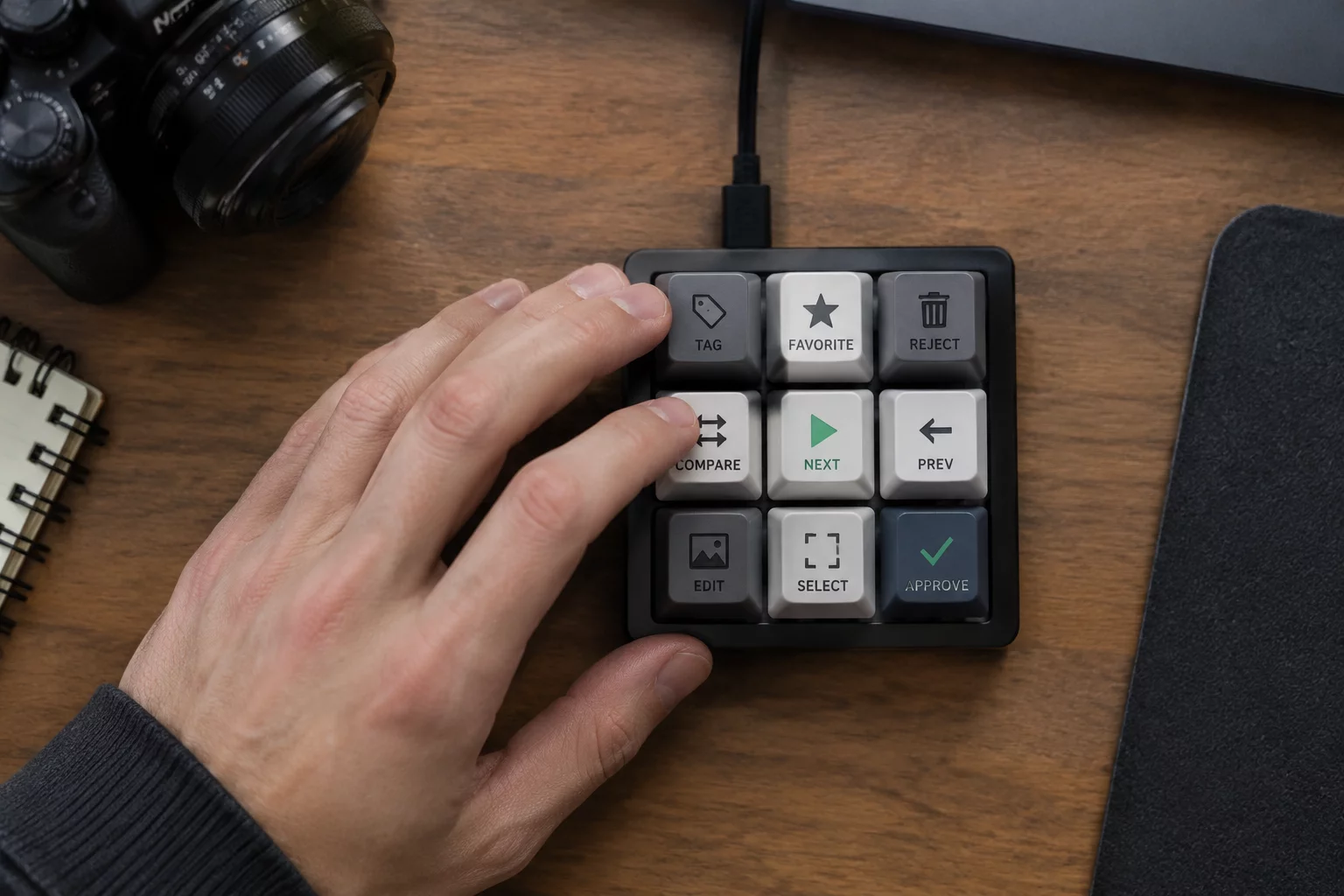
Keyboard Shortcut Ergonomics for Rapid Selection

No comments yet. Be the first to leave a field note on this triage methodology.