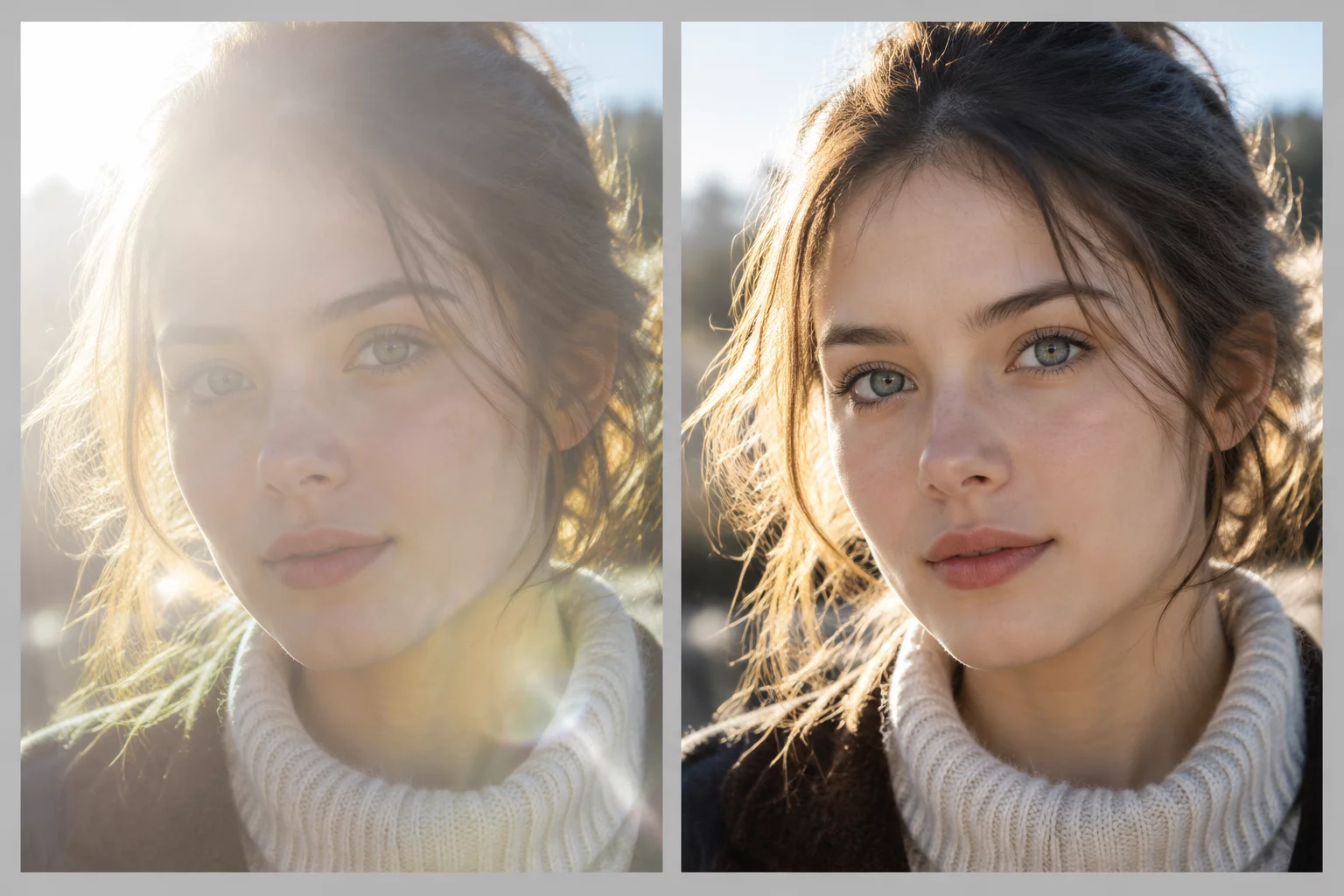
Natural light backlighting introduces high-frequency refraction shifts across prime glass surfaces. When an unshaded front element encounters oblique solar illumination, stray rays scatter between lens groupings, producing a veil that lifts the dark thresholds of the subject's eyelashes, iris perimeter, and hair contours. While atmospheric flare is frequently prized for poetic rendering, slight physical movements by either photographer or subject can cause catastrophic loss of critical ocular contrast.
During the variant comparison pass in SelectPass, adjacent frames exposed within fractions of a second often display drastically divergent micro-contrast. In our reference sequence, tilting the optical axis by less than one single degree caused the sun ray to graze the lens baffle rather than bouncing into the rear group. This preserved punchy tonal delineation across the cheekbone while allowing a soft, organic rim glow along the hair outline.
Optical Verification Criteria
- Primary Reject Signal
- Washed pupil luminance exceeding 18% gray baseline
- Angle Shift Threshold
- 0.5° to 1.5° camera pitch or yaw differential
- Evaluation Loupe Zoom
- 100% inspection on shadow-side ocular catchlight
- Color Tag Classification
- Yellow (Marginal Contrast) vs Green (Keeper Frame)
To evaluate backlit sequences efficiently without succumbing to visual adaptation, curating teams should implement a strict three-tier ocular pass before rating artistic atmosphere:
- Lock the 100% Loupe directly onto the eye nearest the light source, auditing black-point clipping in the pupil.
- Compare paired frames in split view to identify whether edge flare bleeds over critical facial contour lines.
- Verify that background highlight blowout has not caused ghosting artifacts across skin tones or clothing folds.
If the pupil appears milky or foggy under 100% magnification, the raw data cannot be salvaged through local dehaze adjustments without introducing chroma noise. Such frames are tagged Red and rejected immediately, preserving only variants where mechanical refraction remains confined to the image periphery.
Commercial art directors frequently request sun-drenched naturalistic imagery, yet commercial packaging and editorial layouts require crisp focal separation to survive print screening and responsive web compression. When flare blankets the entire histogram, subject isolation fails, flattening facial structure into a two-dimensional silhouette.
The keeper frame demonstrates ideal micro-refraction behavior: golden rim highlights outline the subject's crown, while optical flare forms a distinct circular crescent in the upper quadrant, completely clear of the facial geometry. The skin tones preserve full micro-contrast and accurate tonal gradation from highlight rolloff to deep shadow.
Apply these selection questions in your workspace: Selection Passes and Variants in Capture One.
Curation Frameworks & Shortlist Protocols
Discover how to narrow high-volume natural light sessions down to tight client shortlists without sacrificing atmospheric character.
Micro-Blink Versus Intentional Downward Gaze
Hand Placement Micro-Adjustments in Editorial
High-Speed Shutter Cadence in Event Work

No field notes yet. Be the first to leave a comment on this curation variant.